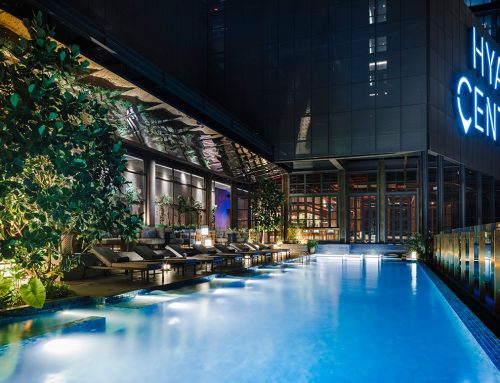
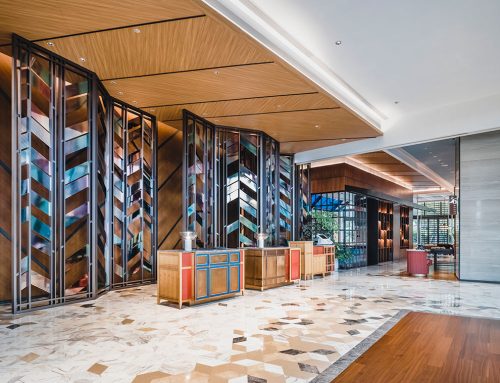
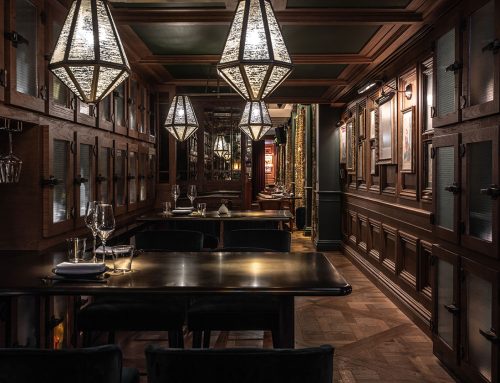
Warayaki, the Japanese art of cooking with straw, is centerstage at Strawfire in Abu Dhabi.
Silverfox Studios | The Shimenawa rope, a braided rope made from rice straw, is revered in Shintoism. Commonly placed at gateways to temples, the rope marks a boundary between the spiritual and the mundane. During the New Year period, wreaths of shimenawa are placed on the doors of family homes to welcome a clean start.

Shimenawa are made from rice straw, a byproduct of rice cultivation: rice-growing has come to shape many parts of Japanese rural life, with harvest festivals marking the passing of time. Anthropologists have even speculated that the labour-intensive nature of rice cultivation led to the formation of more cooperative cultures in places like Japan, an idea colloquially known as the “rice theory”. With Strawfire at the Mandarin Oriental Emirates Palace, Abu Dhabi, Silverfox Studios celebrates the expressive art of warayaki cooking, the spirit of community, and the joy of harvest.
Strawfire was developed to depict the height of the harvest season in rural Japan. Guided by imagery of glowing sunsets and fields of straw, the studio set the scene with gold wall coverings, brocaded fabric, and murals of flying cranes and the countryside. Australian chef Ross Shonhan, who curated the menu, worked closely with Silverfox to perfect his vision.
Warayaki cooking, a traditional method from Kochi Prefecture, is the use of burning straw to sear meat: this leaves it lightly roasted on the outside and rare on the inside. Believed to date back to the 17th century, warayaki cooking is a spectacle: the straw produces bright, intense flames and a delicate aroma. Strawfire is named for the two primary components of warayaki cooking: Silverfox Studios and Shonhan made them central to the experience. Though maximal in its approach, the studio rejected elaborate designs in favour of recognisable silhouettes.
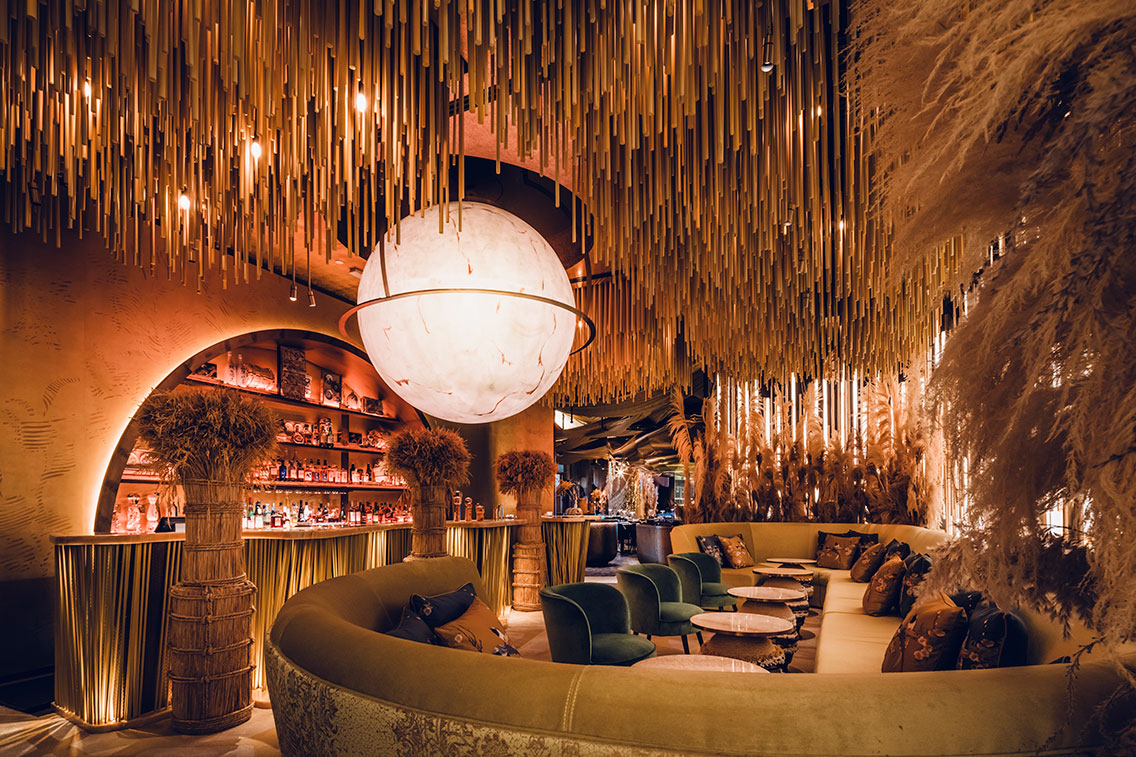
At the entrance, guests are greeted by an interactive display screen, curved to immerse visitors in an idyllic traditional Japanese landscape. Past the door, guests enter the Tsukimi Lounge, a golden room decorated with straw bales. Over the bar counter, in the center of the room, an illuminated globe represents the full harvest moon: Tsukimi (moon-viewing) is a Japanese harvest festival celebrated in autumn. It is here, as the Michelin Guide 2025 declares, that Abu Dhabi’s best cocktails are served.

A long banquet table adds to a celebrative atmosphere, studded with cocktail tables: the upholstery is gold velvet with contrasting cushions. There are no visible lighting appliances: instead, a sea of tubes in gradated colours, installed on the ceiling, project natural-looking light. The visual effect of these tubes is a room blanketed in straw.
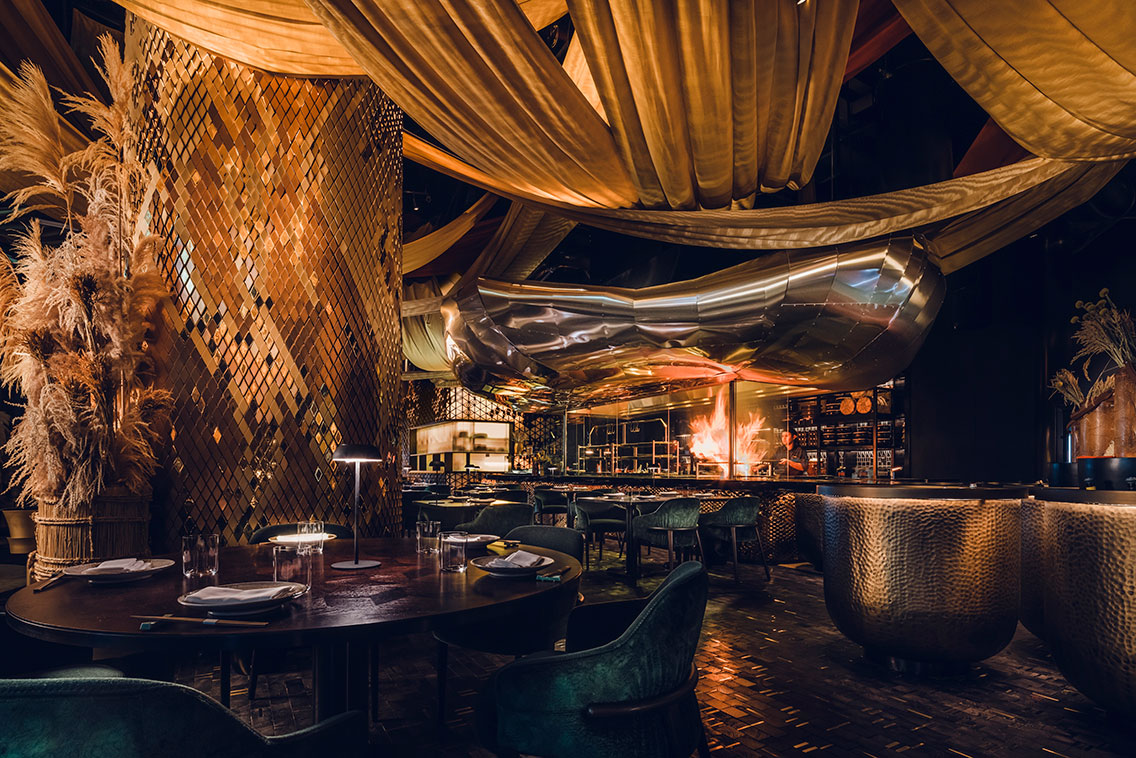
The “heart of the fire”, the Main Dining Room, is aesthetically defined by the flowing fabric that drapes from the ceiling. Arranged like the woven straw of a basket, its colours are more suggestive of the warm tones of fire. Across from the seats, the Grill Kitchen also assumes an organic shape: the hood over it is soft and curved to resemble a golden cloud.
Softer and more immersive, there are more abstract shapes in the Main Dining Room, which complement displays of live cooking at the Grill Kitchen. Chefs in this open kitchen, the focal point of the room, can be seen grilling food: at conceptual stages, the theatrics of warayaki cooking were compared to those of Japanese blacksmiths at work. Straw bale barrels, dotted across the Grill Kitchen and dining floor, double as storage spaces.
The kitchen is left partially visible through a glass screen with Kumiko panels: these are made with a traditional Japanese woodworking technique that dates back to the Asuka era. Through meticulous carving and arrangement, wooden pieces are held together in intricate formations without the use of glue, nails or external tools.
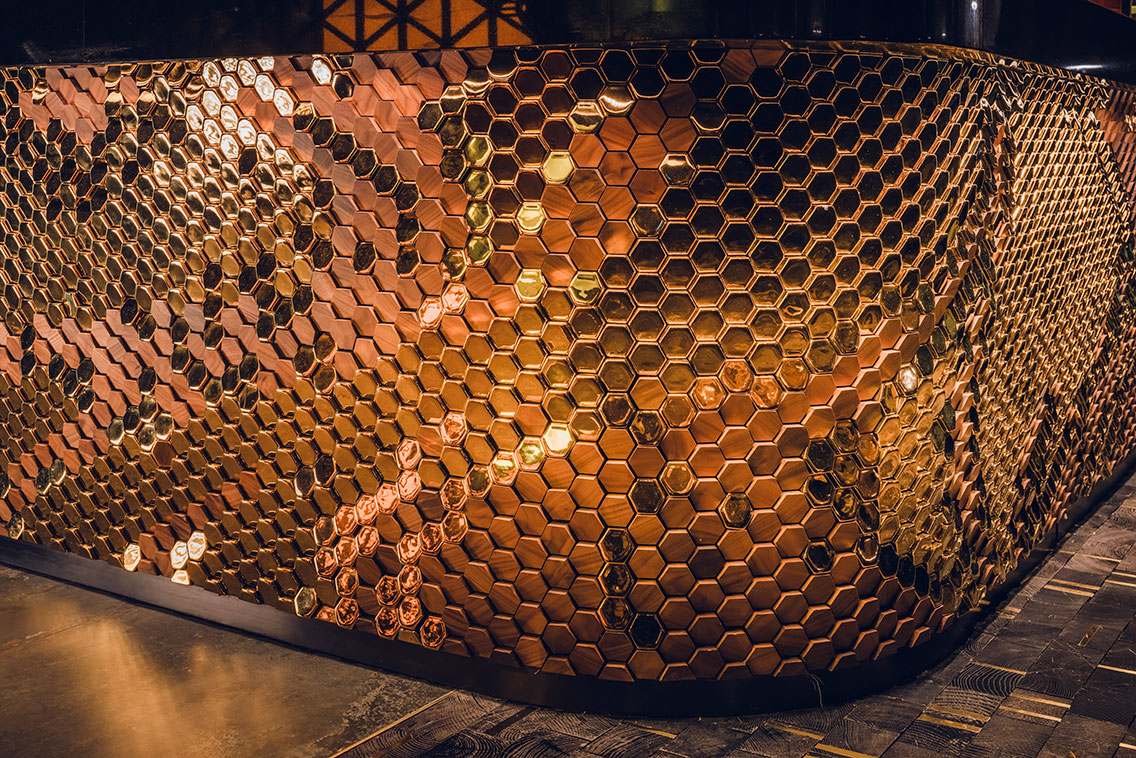
The aged meat display, butcher’s block, grilling counter and main pillar feature specialty tiles by Giles Miller Studio, a London-based design, artistic and architectural studio. Fragmented, glossy gold tiles are placed against dark timber, like fish scales: the scattered patterns of light they reflect resemble flickering flames. The wood floors are threaded with brass inlay: immediately reminiscent of the Japanese art of kintsugi.

The world’s largest synthetic shimenawa rope is here in the Toyama Private Dining Room, surrounded by murals of traditional Japanese harvest scenes. Guests enter this room through a hidden side door, slipping away into a deeply contemplative space.
Strawfire’s shimenawa rope is 7.3 meters long, weighs 830 kilograms, and was hand-made by Nawawaseya artisans in Toyama, Japan. The Private Dining Room is named for Toyama, home to Toyama Bay and the source of Japan’s finest seafood: it thematically honours Toyama’s fishermen and agricultural past.
The room’s murals are hand-painted silk creation by de Gournay, a bespoke furnishing supplier, depicting Japanese mountains, horse riding festivals, and rice and straw farming. It envelops the walls and ceiling, from which the shimenawa rope hangs. Silverfox Studios, characteristically culturally sensitive, has been mindful of the shimenawa’s powerful symbolism. The surrounding panels slide away to allow chefs direct access from a private chef’s kitchen: the cocktail bar in the Tsukimi Lounge is also discreetly accessible.
Project: Strawfire, Mandarin Oriental Emirates Palace
Location: Abu Dhabi
Design Studio: Silverfox Studios
Photo Credits: Ooki Jingu
Website: silverfoxstudios.design